Compare banking rails with the actual job in front of your team
Fintech teams usually are not choosing a rail in isolation. They are choosing how to collect funds, reconcile balances, move value between fiat and crypto, and pay out recipients without adding avoidable operational work.
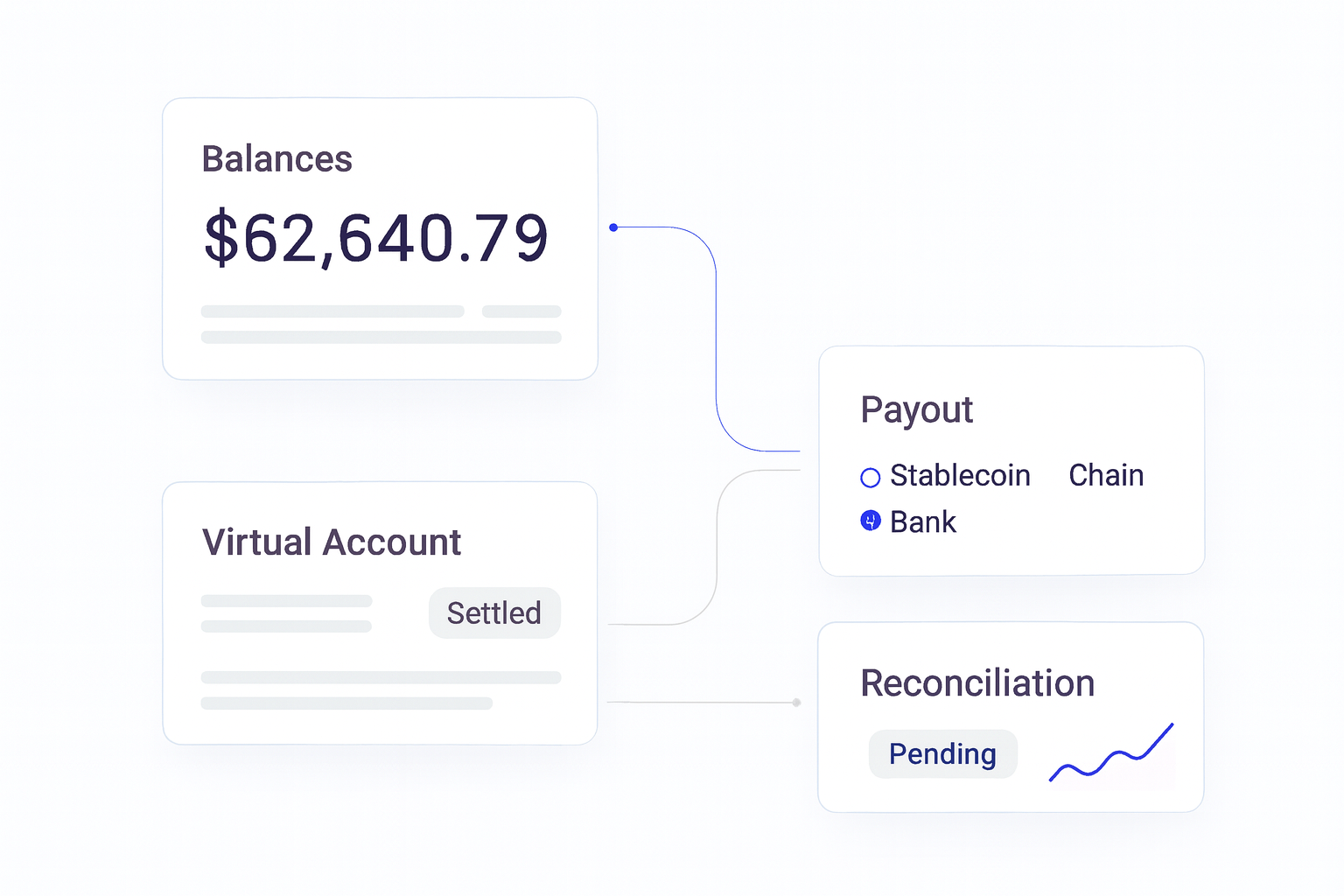
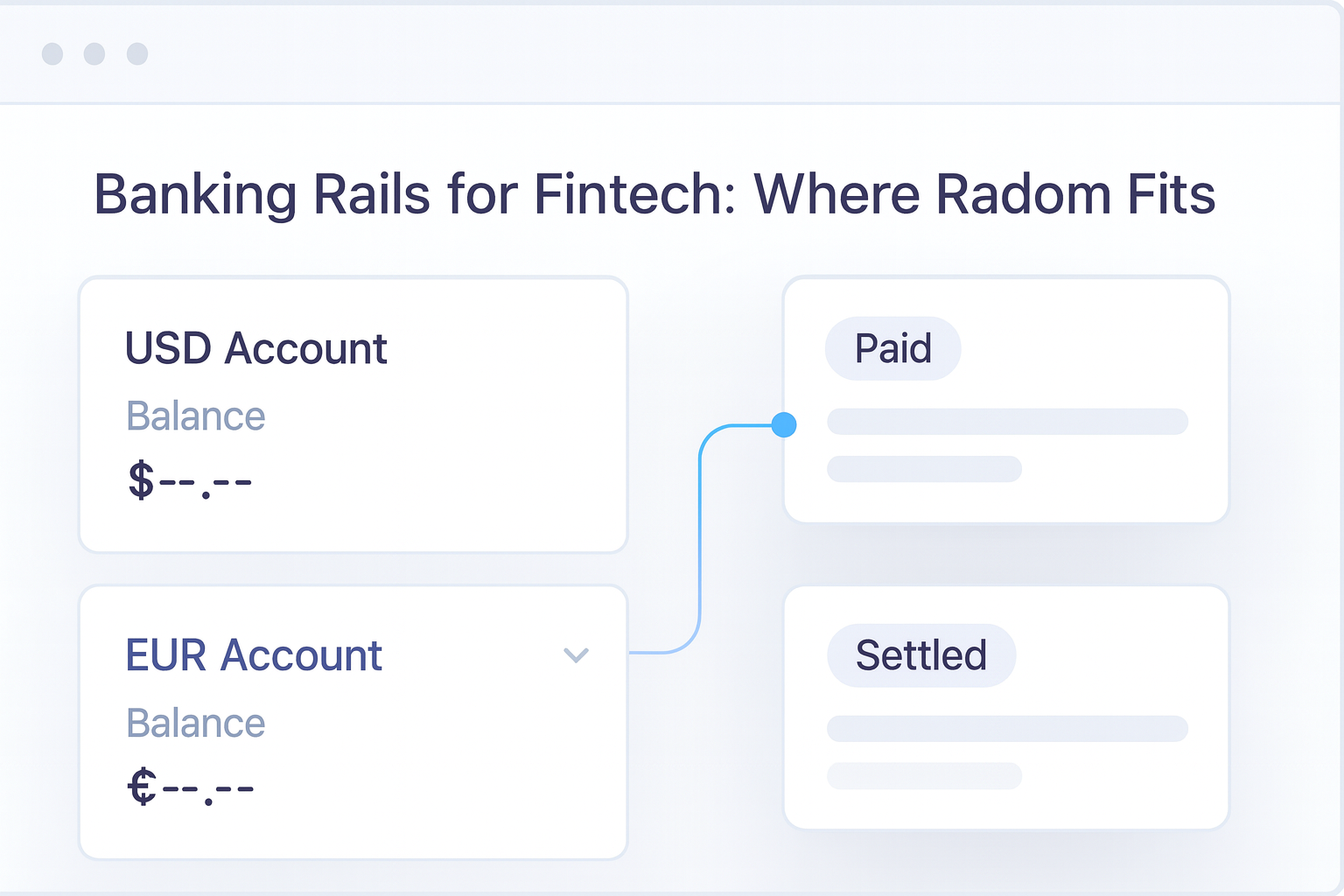
Radom is built for that layer of the stack. It gives businesses named virtual USD and EUR accounts, crypto and fiat movement tools, and payout workflows that can sit alongside payment acceptance, settlement, and treasury operations.
If your team is comparing banking rails for fintech infrastructure, the useful question is not whether a provider offers an account number. It is whether the platform supports the collection, conversion, and payout paths your business actually needs. For Radom, that includes virtual accounts, crypto on and off ramp workflows, crypto conversion, and mass payouts.
Compare Radom pricing or contact sales if you need a setup that spans fiat, stablecoins, and payout operations.
Where Radom fits in a fintech rails stack
Radom is a good fit for internet businesses and platform operators that need more than a single-purpose account. It is designed for teams that want to:
- Receive funds into named virtual accounts in USD or EUR where supported.
- Route balances into crypto or treasury workflows.
- Move between supported crypto, stablecoins, and fiat rails where available.
- Send payouts to affiliates, creators, contractors, sellers, or users.
- Keep payment status and settlement records visible to finance and operations teams.
That makes Radom relevant for fintech products, marketplaces, affiliate networks, creator platforms, subscription businesses, and operators with cross-border payment operations.
Decision criteria that matter more than a rail label
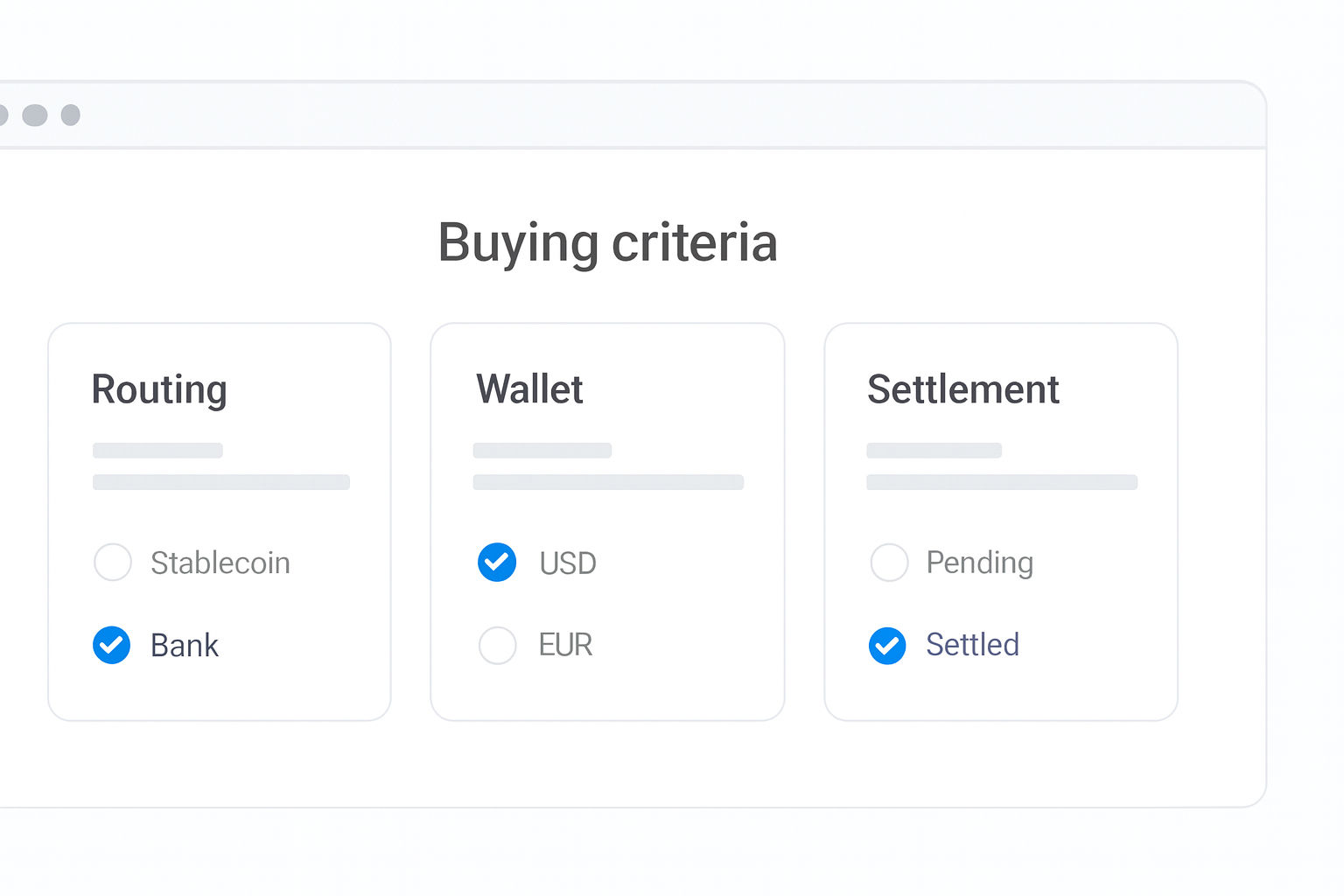
When comparing banking rails for fintech, use criteria that map to operating reality:
- Collection path: Can you collect fiat into a named account and keep the accounting clear?
- Settlement path: Can funds move into the asset your team wants to hold or pay out from?
- Conversion path: Can you convert between supported digital assets and fiat without breaking reporting?
- Payout path: Can you send fiat or crypto to the recipient and rail they need?
- Workflow fit: Can finance teams use the dashboard, and can developers integrate through APIs where needed?
Radom addresses those needs through virtual accounts, conversion tools, payouts, and payment APIs. For teams that need recurring revenue flows as well, the same platform also supports crypto billing, invoices, and payment links through the broader product suite.
How Radom removes work for operators
Radom reduces the number of separate tools needed to manage payment operations. Instead of stitching together a collection provider, a conversion workflow, and a payout tool, teams can use one platform for related money movement tasks.
- Named virtual accounts help with cleaner accounting than pooled collection flows.
- The dashboard shows payment and exchange analytics with detailed accounting.
- Settlement and withdrawal automations can route funds into the right asset and destination.
- CSV upload and API options support both operations-led and developer-led workflows.
For teams evaluating the stack, that can simplify reconciliation, treasury handling, and payout execution without forcing every payment flow into the same rail.
When Radom is a better fit than a generic banking rail
Radom is worth a closer look if your business needs to work across fiat and crypto rather than treating them as separate systems. It is especially relevant if you:
- Collect fiat from customers or counterparties and want to settle into crypto workflows.
- Hold balances across stablecoins and fiat for operational reasons.
- Run global payouts to many recipients.
- Need payment infrastructure that fits a platform model rather than a consumer banking product.
If your only requirement is a basic business account, a traditional banking rail may be enough. If you need payment acceptance, virtual accounts, conversion, and payouts in one operating layer, Radom is built for that use case.
For teams comparing implementation paths
Finance and payments teams often start with the dashboard, then move to API integration once the workflow is clear. Radom supports both paths.
That matters for:
- Founders who want a fast setup before committing to deeper integration.
- Finance operations teams that need visibility into balances, settlement, and reconciliation.
- Developers who want programmable payment infrastructure and documented workflows.
If you are still evaluating the fit, start with the product pages for virtual accounts, crypto convert, and mass payouts, then move to pricing or contact sales for a setup discussion.
Frequently asked questions
Is Radom a bank?+
No. Radom should be understood as financial infrastructure for businesses. When using virtual accounts or fiat rails, keep the language precise and refer to the available partner-supported rails and product flows.
Can Radom handle both fiat and crypto workflows?+
Yes. Radom supports virtual accounts, crypto and fiat movement workflows, conversion, and payouts. Exact availability depends on the rail and use case.
Who is this page for?+
This page is for fintech teams, payments operators, founders, finance operations teams, platform operators, and developers comparing banking rails with crypto-native settlement and payout infrastructure.
What should we do next if we need a custom setup?+
Review the product pages, check pricing, and contact sales if you need a workflow that spans collection, conversion, and payouts.
Explore virtual accounts or contact sales for a tailored walkthrough.