Virtual accounts

Virtual accounts for clearer payment operations

Give customer, merchant, or treasury collections distinct bank details, then connect each inbound transfer to the right ledger record and supported settlement route.

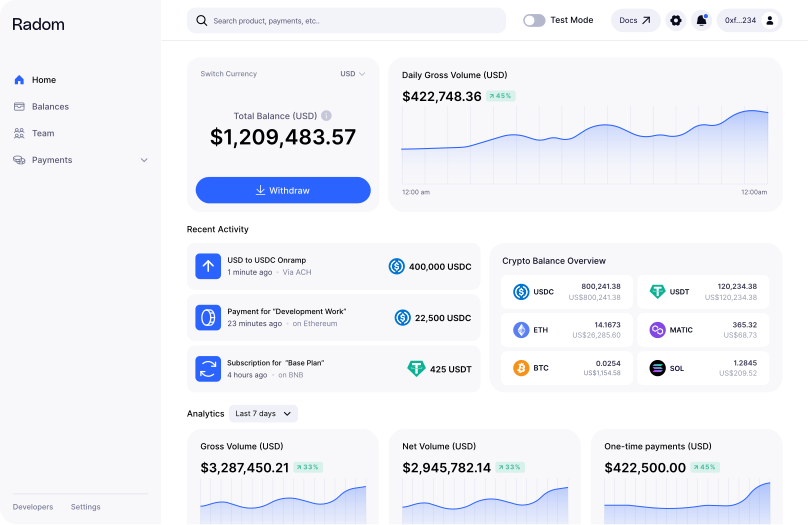
Radom virtual account interface visual for bank collection and settlement operations
01

Named inbound collection

Use enabled virtual account details for repeat or operationally structured fiat deposits rather than treating every inbound transfer as an anonymous shared-account event.

02

Multiple account formats

Public documentation describes USD account and routing details, EUR IBAN and SEPA details, MXN CLABE details, and BRL Pix collection details, subject to coverage.

03

Customer and workflow attribution

Map each issued account to the customer, merchant, legal entity, or treasury workflow represented in your own system of record.

What is a virtual account?

A virtual account provides reusable fiat collection details assigned to a customer, merchant, entity, or operating workflow so inbound transfers can be attributed. Radom connects enabled virtual accounts to reconciliation and supported crypto settlement. Public documentation describes enabled USD account and routing details, EUR IBAN and SEPA details, MXN CLABE details, and BRL Pix details. The account type, region, settlement asset, destination network, and operating model depend on onboarding and the capabilities enabled for your organisation.

Who this is for—and when it is not the right route

Good fit

Platforms with repeat collections

Assign inbound bank details to a customer, merchant entity, or operational workflow so transfers can be attributed without a shared-reference guessing game.

Crypto and fintech treasury teams

Connect supported fiat collection to enabled crypto balances while retaining the account, currency, settlement asset, and network in the operating record.

Finance and reconciliation teams

Maintain a durable mapping from the assigned collection account to the internal customer or ledger entity that owns the resulting balance movement.

Use another route when

A checkout-led bank payment

Use Open Banking when the payer should choose a bank and initiate a transfer for a specific order inside a checkout journey.

Direct on-chain collection

Use dedicated crypto deposit addresses when the sender already holds a supported digital asset and the collection should start on-chain.

Universal account coverage

Do not design around every account type, country, currency, settlement asset, or network being available. Coverage is specific to your organisation and route.

A connected operating workflow

01

Named inbound collection

Use enabled virtual account details for repeat or operationally structured fiat deposits rather than treating every inbound transfer as an anonymous shared-account event.

02

Multiple account formats

Public documentation describes USD account and routing details, EUR IBAN and SEPA details, MXN CLABE details, and BRL Pix collection details, subject to coverage.

03

Customer and workflow attribution

Map each issued account to the customer, merchant, legal entity, or treasury workflow represented in your own system of record.

04

Supported crypto settlement

Connect eligible fiat deposits to an enabled crypto balance, with the settlement asset and destination network confirmed before launch.

05

Webhook-led operations

Use Radom event delivery or related operational tooling to drive deposit processing, reconciliation, notifications, and exception queues.

06

Connected treasury routes

Where enabled, use conversion and payout workflows after collection rather than moving funds through an unrelated, difficult-to-reconcile stack.

From requirements to reconciled operation

  1. 01

    Define the attribution model

    Choose whether each virtual account represents a customer, merchant, business entity, treasury purpose, or another durable ledger dimension.

    Control: Do not issue accounts before deciding which internal record owns every resulting deposit and exception.

  2. 02

    Confirm the enabled route

    Agree the account type, currency, region, expected payer profile, settlement asset, destination network, and intended downstream use with Radom.

    Control: Treat public coverage as a product description, not organisation-specific approval or availability.

  3. 03

    Store the account mapping

    Persist the Radom account identifier and supplied bank details against the correct internal entity before exposing them to a payer.

    Control: Restrict changes to account ownership and settlement destinations through appropriate permissions and review.

  4. 04

    Present precise payment instructions

    Show the enabled account details, supported currency, beneficiary information, and any payer instructions exactly as configured.

    Control: Prevent customers from substituting unsupported currencies, account fields, or payment methods.

  5. 05

    Process inbound activity

    Receive the relevant operational event, match the account to your internal entity, and keep processing pending until the deposit reaches the final state used by your workflow.

    Control: Make event handling idempotent and route unmatched, duplicated, delayed, or returned transfers to an exception queue.

  6. 06

    Reconcile settlement

    Record the source account, fiat amount and currency, Radom identifiers, settlement asset and network, timestamps, fees when supplied, and resulting balance movement.

    Control: Reconcile source and destination legs independently so a collection is not mistaken for completed downstream treasury movement.

Choose the route by operating requirement

RouteUse whenPlan for
Virtual accountsA customer, merchant, or treasury workflow needs repeatable bank collection details and durable inbound attribution.Account type, region, currency, payer instructions, settlement asset, and destination network are configuration-specific.
Open Banking checkoutA payer should choose a bank and initiate a transfer as part of a particular checkout or funding session.The journey is asynchronous; a redirect or bank authorisation is not final proof of payment.
Crypto deposit addressThe sender already holds a supported digital asset and the inbound flow should be attributed on-chain.Network selection, deposit minimums, confirmation state, and address ownership need explicit controls.
PayoutsThe operating need is to disburse an existing balance rather than collect an inbound bank transfer.Beneficiary data, funding balance, corridor, destination type, and permissions govern the payout route.

Reconciliation and controls

Durable account ownership

Keep one authoritative mapping between the Radom virtual account, the internal customer or entity, and the ledger account that receives the collection.

Separate collection from settlement

Record the inbound fiat event and the resulting crypto balance movement as linked but distinct operational legs.

Idempotent event processing

Deduplicate webhook messages, record state transitions, and make ledger posting and customer notification safe to retry.

Exception ownership

Assign teams and response rules for unmatched transfers, unsupported currencies, delayed settlement, returns, duplicates, and account-detail changes.

Know the boundaries before launch

Coverage is organisation-specific

Supported account types and corridors depend on region, onboarding, enabled capabilities, and the exact operating model.

Settlement is not identical across currencies

Public documentation describes different settlement assets and network choices by account type. Confirm the production route rather than generalising one setup.

An account number is not reconciliation

The operational value comes from a reliable ownership map, event processing, ledger posting, and exception process around the account details.

This is not legal or accounting advice

Your legal, compliance, tax, and finance teams should determine how accounts, payer relationships, funds flows, and settlement are treated for the business.

Practical answers

What is a Radom virtual account?

It is a named fiat collection account used to receive bank-led deposits into Radom while keeping attribution clearer than a shared-account model. Availability and the exact account details depend on your organisation and region.

Which virtual account types does Radom describe publicly?

Radom's public documentation describes enabled USD accounts with account and routing details, EUR accounts with IBAN and SEPA details, MXN accounts with CLABE details, and BRL accounts with Pix details. Confirm the account types enabled for your organisation.

How do virtual account deposits settle?

Public documentation says virtual account deposits generally settle into supported crypto balances. The settlement asset and destination network differ by account type and configuration and must be confirmed before launch.

Are virtual accounts available to every business and country?

No universal availability is promised. Region, onboarding status, organisation permissions, required account type, currency, settlement model, and intended use all affect coverage.

When should we use Open Banking instead?

Use Open Banking when a payer should initiate a bank transfer for a particular checkout or funding session. Use a virtual account when the business needs reusable collection details and repeat attribution.

How should virtual account deposits be reconciled?

Store the virtual account and Radom identifiers against your internal customer or ledger entity, process events idempotently, and record the fiat source leg separately from the resulting settlement balance movement.

Product and implementation references

Reference material for the product capabilities and implementation notes on this page. Confirm the exact route and availability for your organisation before launch.

Radom virtual accounts guide

Account types, use cases, settlement models, networks, and rollout.

Primary public documentation for the account coverage and settlement behaviour described on this page.
Radom webhook guide

Event verification, retry behaviour, and idempotent processing.

Primary public documentation for event-driven reconciliation and operational handling.
Radom Conversion API guide

Supported pairs, minimum amounts, quotes, and quote acceptance.

Primary public documentation for optional downstream conversion after collection.

Build the right virtual accounts setup for your operation.

Discuss a virtual account flow