
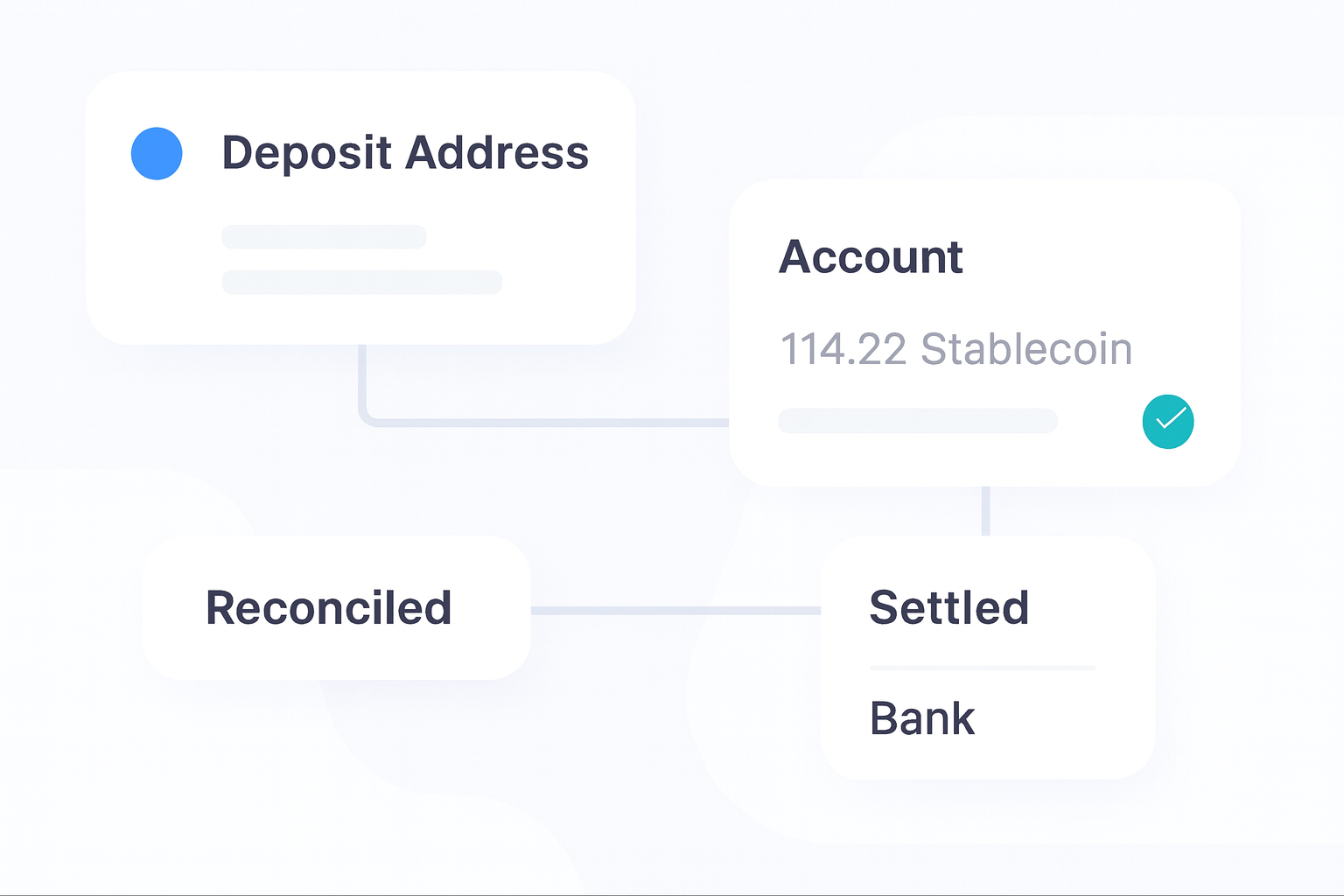
Dedicated crypto deposit addresses solve a practical business problem
If your team accepts repeated crypto payments, you need a reliable way to know who paid, what they paid for, and where the funds should go next. A dedicated crypto deposit address gives each customer, account, or workflow its own payment destination, which makes reconciliation cleaner and reduces manual matching.
Radom supports dedicated deposit addresses for businesses that need account-level tracking, repeat payments, and simpler settlement workflows. That is useful for operators managing top-ups, invoice payments, user balances, or recurring account funding.
For teams evaluating payment infrastructure, the core question is not just whether you can accept crypto. It is whether you can assign incoming funds correctly and keep finance operations under control.
When a business should use deposit addresses
Use deposit addresses when you want a stable destination for repeat payments or when you need to map each incoming transfer to a specific user or account. Common cases include:
- Customer top-ups and account funding
- Invoice collection with payment references tied to a user or workflow
- Wallet-based payment experiences where senders reuse the same address
- Platform balances that need clean internal attribution
- Operations teams that want less manual reconciliation work
If your business needs a broader acceptance flow, Radom also supports crypto payments, checkout, payment links, billing, subscriptions, and invoices. Explore crypto payments.
How to set up a crypto deposit address for business
- Define the business object you want to track, such as a user, account, invoice, or internal workflow.
- Create a dedicated deposit address for that object.
- Store the address against the correct customer or account ID.
- Route future deposits to the right balance, record, or workflow.
- Use your finance process to match deposits, settlement, and conversion outcomes.
With Radom, you can create deposit channels through the API, link addresses to user IDs, and route future deposits automatically. That matters for teams that need a predictable operational process rather than a one-off wallet address list.
Where Radom removes work for operators
Radom is designed to reduce the manual steps around deposit tracking and settlement. The platform lets teams assign deposit addresses by user, account, or workflow, then use built-in conversion tools to move incoming crypto into other digital assets or fiat where supported.
That helps finance and operations teams keep incoming deposits aligned with treasury and reporting needs instead of handling every transfer manually. For teams that also need fiat collection or named accounts, Radom offers virtual USD and EUR accounts for business workflows. See virtual accounts.
If your team wants to automate payment handling, reconciliation, or wallet-based workflows, the documentation is the best place to start. Read the docs.
What to check before you launch
Before you use deposit addresses in production, confirm how your team will handle attribution, settlement, and conversion. The main operational questions are:
- Which object owns the address: user, account, invoice, or internal workflow?
- How will deposits be matched to the correct record?
- Will incoming funds stay in crypto, convert to stablecoins, or move to fiat where supported?
- Who in finance reviews exceptions and unmatched deposits?
- What happens when the same sender pays again?
For businesses that want a simple starting point, Radom pricing is per transaction and does not include setup fees or monthly fees. Review pricing.
Who this is for
This workflow is a strong fit for payments teams, founders, finance operations teams, platform operators, affiliate and iGaming operators, creator platforms, subscription businesses, and developers building crypto payment infrastructure. If your business needs dedicated addresses, cleaner reconciliation, and account-level tracking, the operational value is usually immediate.
Frequently asked questions
What is a crypto deposit address for business?+
It is a dedicated crypto address assigned to a customer, account, invoice, or workflow so incoming payments can be tracked and reconciled more easily.
Why use dedicated deposit addresses instead of one shared wallet?+
Dedicated addresses make attribution cleaner, reduce manual matching, and give finance teams better control over reconciliation.
Can deposit addresses be linked to a user ID?+
Yes. Radom's API can create deposit channels and link addresses to user IDs so future deposits route to the right account automatically.
Can incoming deposits be converted?+
Radom supports conversion tools that can move incoming deposits into stablecoins, other crypto assets, or fiat where supported.
Is this only for crypto-native businesses?+
No. It is for businesses that need practical payment operations across crypto and related settlement workflows.
Next step
If you need dedicated crypto deposit addresses for business payments, reconciliation, or account-level tracking, start with Radom or speak with sales about your workflow. Contact sales or read the docs.