
Crypto payment infrastructure for PSPs
PSPs and payment companies need more than a checkout page. They need infrastructure that can accept crypto, route funds, manage settlement, support payouts, and keep finance operations readable. Radom is built for that use case. It gives teams one platform for crypto payments, billing, invoices, payment links, payouts, virtual accounts, conversion, and on and off ramp workflows where available.
If your team is evaluating crypto payment infrastructure for a PSP stack, Radom is designed to sit alongside your existing operations rather than replace your core business model. It helps you manage acceptance, balance movement, and payout workflows from a single account. For product and engineering teams, the API and docs provide a programmable path. For operations teams, the dashboard gives a practical way to track settlement and reporting.
Contact sales if you are scoping a PSP rollout or need a setup that spans acceptance, payouts, and settlement.
What PSP teams usually need from crypto infrastructure
When PSPs add crypto rails, the requirements are usually operational rather than speculative. The platform has to support payment collection, clear payment status, reconciliation, and movement into the right asset or payout rail. Finance teams want cleaner settlement records. Operators want less manual work. Developers want APIs that fit existing systems.
- Accept payments through hosted checkout, invoices, payment links, subscriptions, or APIs.
- Track balances and settlement in one place.
- Move between crypto and fiat where supported.
- Support payouts to recipients in crypto or fiat where available.
- Keep accounting and reporting usable for finance operations.
How Radom fits a PSP workflow
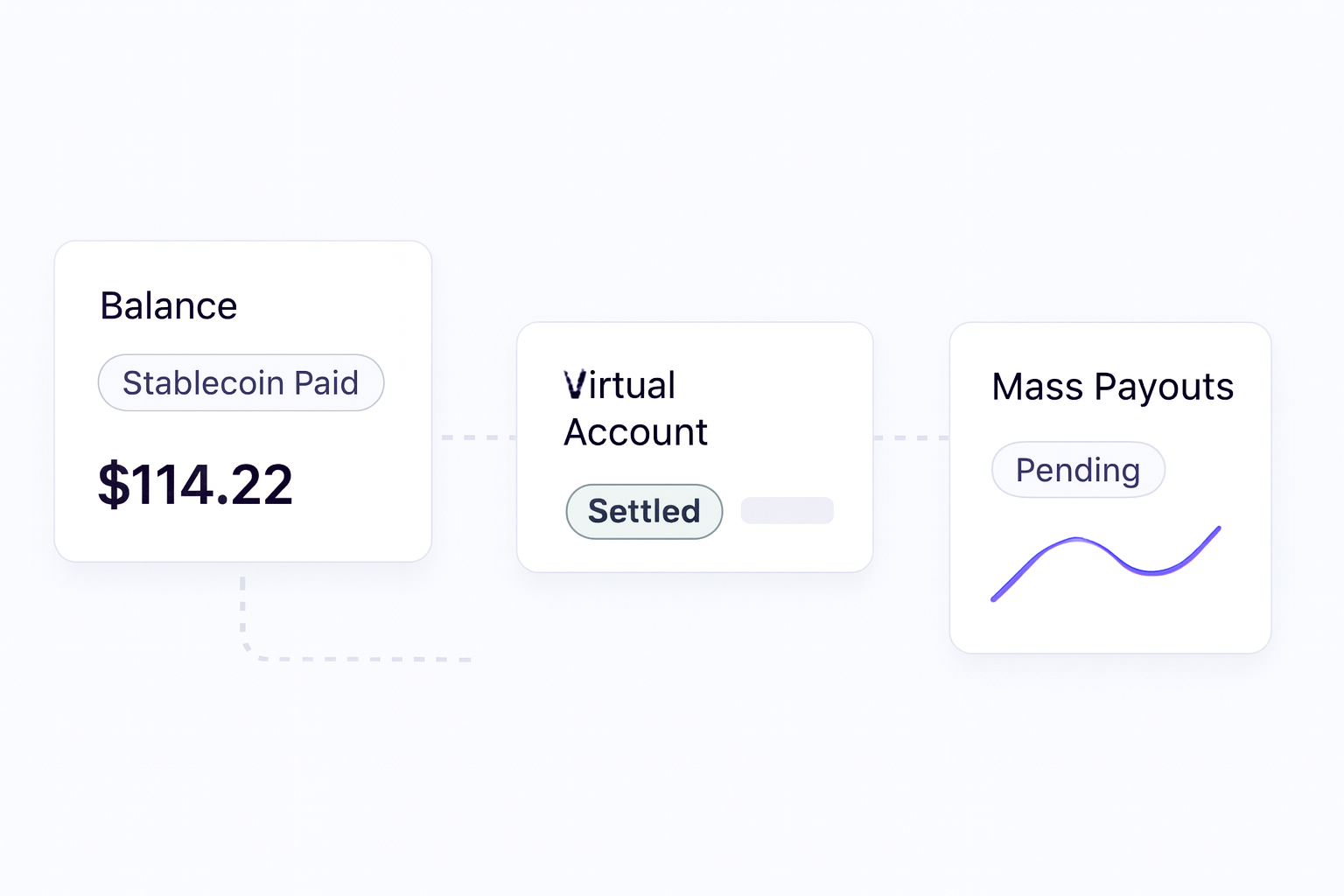
Radom supports the parts of the workflow that PSP teams typically need to connect. You can accept crypto payments, collect funds into virtual accounts where supported, convert balances through the platform, and send payouts to recipients in the rail they need. That makes it useful for PSPs handling merchant settlement, platform payouts, affiliate payments, creator payouts, or other recurring money movement.
The platform also supports mass payouts through the dashboard, CSV upload, or API. For teams that need to move between crypto and fiat, Radom includes crypto convert and crypto on and off ramp workflows where available. If your use case depends on fiat collection or named virtual accounts, the virtual accounts product is the relevant place to start.
Review crypto payments if your first priority is acceptance.
Practical steps for PSPs evaluating Radom
- Map the payment flow you need to support, such as customer acceptance, merchant settlement, or recipient payouts.
- Choose the entry point that matches the workflow, such as crypto payments, payouts, virtual accounts, or crypto convert.
- Check whether your team needs dashboard operations, CSV uploads, API access, or all three.
- Confirm which settlement currencies and payout rails are relevant for your route.
- Use the docs to assess integration effort and event handling.
- Route high-volume or multi-product requirements to sales before implementation.
For developers, the fastest next step is the documentation. For operators, a sales conversation is usually the best way to confirm fit across acceptance, conversion, and payout workflows.
Open the docs to review integration details.
Where Radom removes work
PSP teams often end up stitching together separate tools for acceptance, conversion, settlement, and payouts. That creates duplicate reporting, more manual reconciliation, and more internal support overhead. Radom reduces that by keeping the operational layer in one platform.
- One account for payments, payouts, conversion, and settlement workflows.
- Dashboard, CSV, and API options for different operating models.
- Named virtual accounts where supported for cleaner receipt flows.
- Clearer balance tracking for finance and operations teams.
If your current stack already handles cards or bank rails, Radom can sit next to it as a crypto-native payment layer rather than forcing a full replacement.
Pricing and rollout
Radom’s pricing page states that pricing is per transaction, with no setup fees or monthly fees. If you are evaluating a PSP rollout, pricing should be checked alongside your expected volume, payment mix, and settlement needs. For larger or more complex cases, contact sales before you commit to a rollout plan.
See pricing for the current pricing structure.
Frequently asked questions
Is Radom only for crypto businesses?+
No. Radom is built for businesses and platform operators that need payment acceptance, balance management, settlement, conversion, and payouts across crypto and fiat workflows where supported.
Can PSPs use Radom for payouts as well as acceptance?+
Yes. Radom supports mass payouts and also supports crypto payments. That makes it relevant for PSP teams that need both inbound and outbound money movement.
Does Radom support APIs?+
Yes. Radom provides developer APIs and docs for teams that need programmable payment infrastructure.
Can Radom help with fiat collection or virtual accounts?+
Yes, where supported. Radom’s virtual accounts product covers named virtual USD and EUR accounts for collecting fiat payments and moving value into crypto workflows.
What if we need a custom PSP setup?+
Use the docs for technical evaluation and contact sales for rollout planning, volume questions, or multi-product requirements.
Contact sales to discuss your PSP use case.

