Why crypto subscriptions matter for operators
If your business sells recurring services, you need a billing setup that is easy for customers to pay and easy for your team to reconcile. Crypto subscriptions are a practical option for SaaS companies, creator platforms, marketplaces, and other digital businesses that want recurring revenue without relying only on card rails.
Radom helps businesses sell subscriptions and recurring services in crypto with automated billing, clear payment states, and customer-friendly wallet flows. Finance, operations, and product teams can track recurring revenue, failed payments, customer activity, and settlement from one dashboard.
If you are evaluating recurring billing infrastructure, start with crypto billing and review pricing before you decide whether to self-serve or speak with sales.
What a crypto subscription flow should handle
A workable subscription system needs more than a payment button. It should support the billing model you sell, show the current state of each payment, and give your team enough control to manage renewals and exceptions.
- Fixed recurring charges for access or membership
- Metered usage where billing changes with consumption
- Seats, tiers, free trials, discounts, and add-ons
- Defined renewal cycles and payment timing
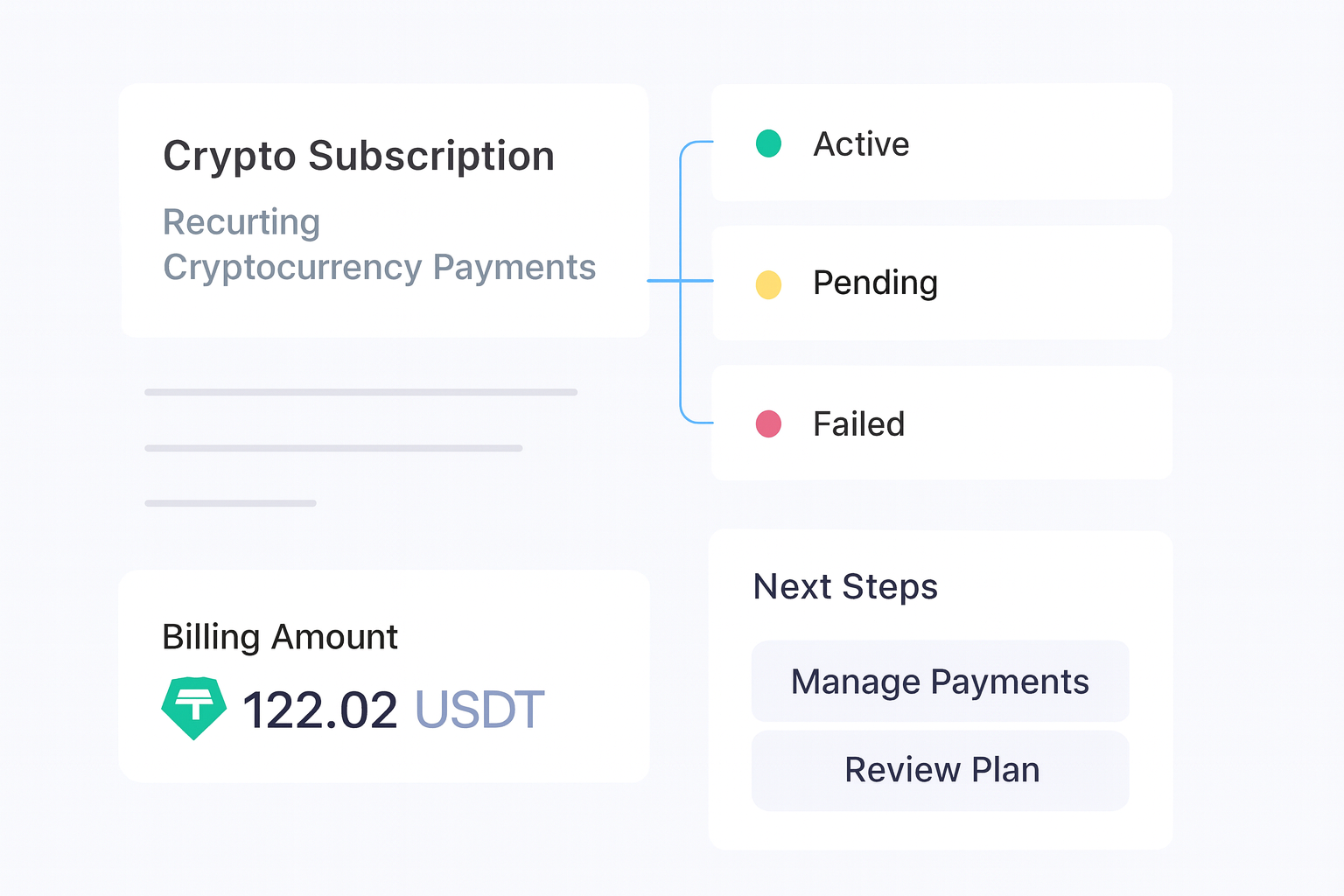
- Clear status tracking for active, failed, and settled payments
- Finance access for reporting and reconciliation
Radom supports billing models buyers expect, including metered usage, seats, tiers, free trials, discounts, add-ons, and custom renewal cycles.
How to set up crypto subscriptions
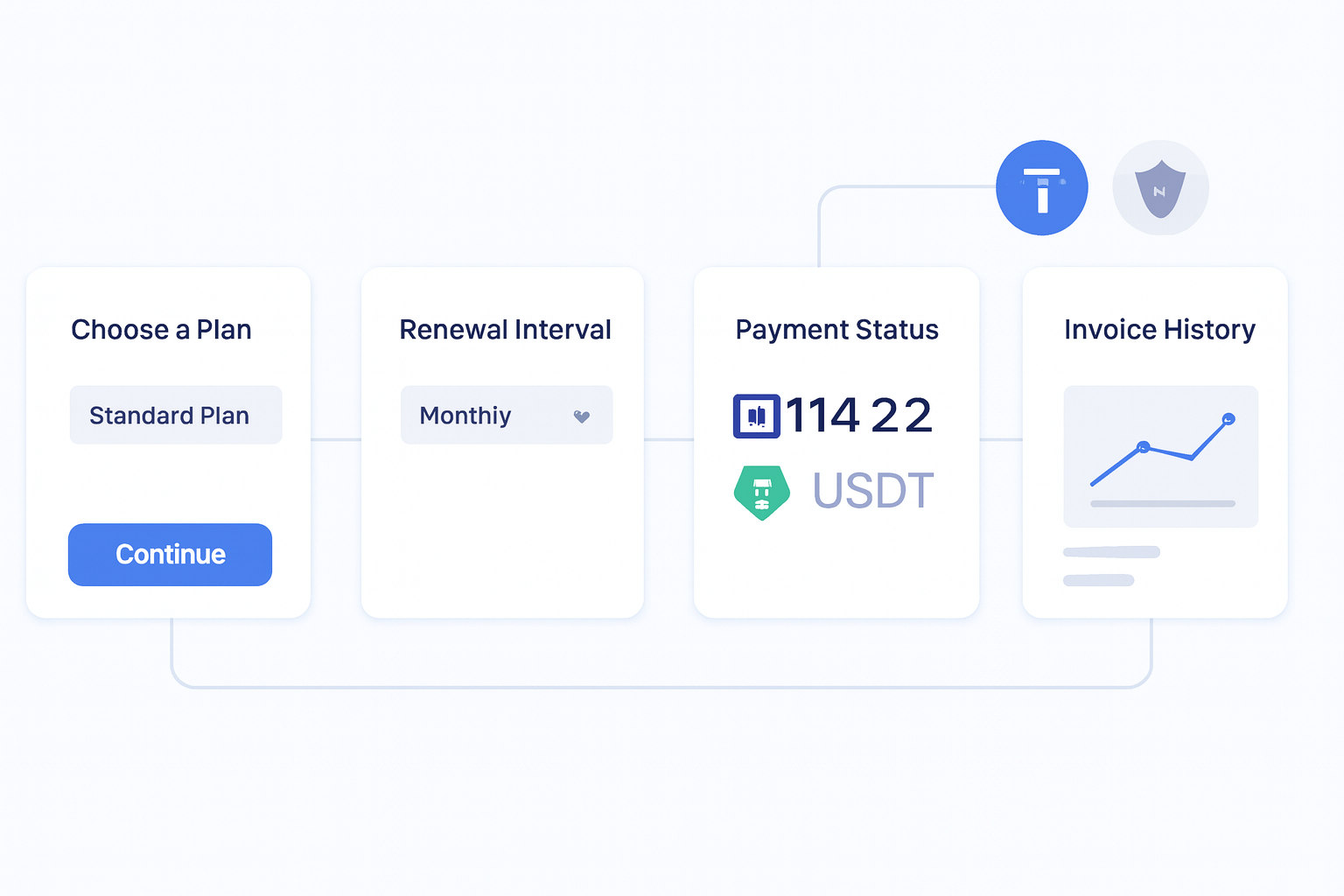
- Define the billing model. Decide whether your product is a fixed subscription, a usage-based plan, a seat-based plan, or a hybrid.
- Choose the customer flow. Use hosted tools if you want a faster launch, or APIs if your team wants to build the experience into your product.
- Set the renewal rules. Confirm the billing interval, trial period, discounts, and any add-ons that should affect the next charge.
- Map payment states. Make sure your team can see which subscriptions are active, pending, failed, or settled.
- Assign internal access. Give finance, operations, and product teams the right roles and permissions for billing management.
- Review settlement and reporting. Decide how you want to track balances, revenue, and customer activity after payment.
For teams that want to move faster, Radom subscriptions automatically pull funds from a customer's wallet to your own at an agreed interval.
Where Radom removes manual work
Recurring billing creates repeated operational tasks. Radom reduces that load by centralising billing management in one place.
- Automated billing reduces manual renewal handling
- Clear payment states help finance and support teams answer customer questions
- Dashboard reporting makes recurring revenue easier to monitor
- Roles and permissions help teams control who can manage billing
- APIs support teams that want to automate invoice creation and payment tracking
If your workflow also depends on invoices, use crypto invoicing alongside billing so finance teams have a clearer receivables process.
When crypto subscriptions are a better fit
Crypto subscriptions tend to make sense when your buyers already operate in crypto, when you sell globally, or when you want a billing setup that can sit closer to your product and treasury operations.
They are often evaluated by SaaS companies, platform operators, affiliate networks, creator businesses, and other digital services that need predictable recurring revenue and a cleaner way to manage settlement.
Radom is built for businesses and platform operators, not only consumers, so the product is suited to teams that need both customer-facing payment flows and back-office control.
How to choose the right setup
Before you launch, check three things: whether your customers can complete the payment flow without confusion, whether your finance team can reconcile the result, and whether your product team can manage renewals without extra manual work.
If you need a broader payments stack, Radom also supports crypto payments, hosted checkout, payment links, and payout workflows. That makes it easier to keep recurring revenue, one-time payments, and settlement in one platform.
Frequently asked questions
What are crypto subscriptions?+
Crypto subscriptions are recurring payment arrangements where a customer pays on a schedule using crypto or stablecoins, depending on the supported flow.
Who uses crypto subscriptions?+
SaaS companies, creator platforms, subscription businesses, marketplaces, and other digital operators use them when they want recurring revenue with crypto-based payment flows.
Can Radom handle billing models beyond simple monthly plans?+
Yes. Radom supports metered usage, seats, tiers, free trials, discounts, add-ons, and custom renewal cycles.
Can finance teams track recurring revenue in Radom?+
Yes. Radom provides a dashboard for recurring revenue, failed payments, customer activity, and settlement.
Should I use billing, invoicing, or checkout?+
Use billing for recurring revenue, invoicing for finance-led receivables workflows, and checkout when you want a hosted payment flow for one-time or recurring purchases.
Next step
If you are evaluating crypto subscriptions for a live product, start with the billing product page, review pricing, and bring in sales if you need a workflow that is more complex than a standard self-serve setup.
Contact sales if you want to talk through your billing model, or use the docs to plan an integration path.