
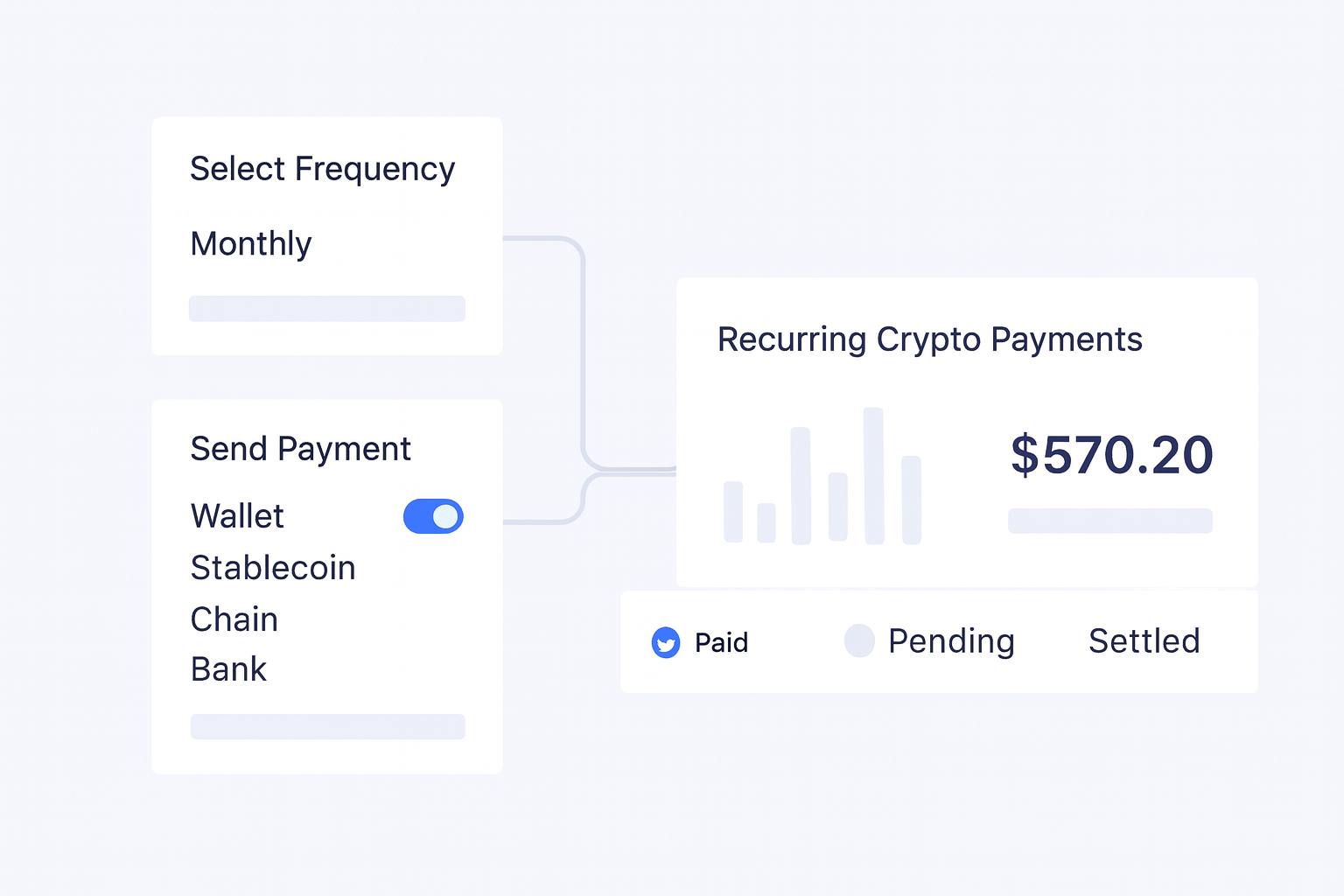
How to set up recurring crypto payments
If you want to sell subscriptions or recurring services in crypto, the setup should do three things well: create a clear billing schedule, collect payments from a customer wallet on time, and give your team a reliable view of payment status and settlement. Radom is built for businesses that need that workflow without stitching together separate tools for billing, invoicing, and payment operations.
This guide covers the practical setup flow for teams evaluating recurring crypto payments, especially SaaS, creator platforms, marketplaces, affiliate programs, and other internet businesses with subscription revenue.
1. Define the billing model first
Start with the commercial model before you think about the payment flow. Decide whether the plan is fixed price, usage-based, tiered, seat-based, trial-led, discounted, or a mix of those models. Radom supports billing models buyers expect, including metered usage, seats, tiers, free trials, discounts, add-ons, and custom renewal cycles.
If your pricing changes by customer segment or usage, map those rules before launch. That keeps billing logic consistent and reduces manual work later.
2. Choose how customers will pay
Recurring crypto payments can be presented through hosted tools or integrated through APIs, depending on how much control your team needs. Radom offers hosted tools for customer subscription management and APIs for developers who want to integrate crypto payments directly. That gives you a path for both no-code launch and deeper product integration.
For teams that want a faster rollout, start with a hosted flow and move to API-driven automation once the billing model is stable.
3. Set up the customer payment experience
Customers need a payment flow they can understand quickly. Radom supports customer-friendly wallet flows and clear payment states, which matters when you are asking users to approve repeat payments rather than a one-time checkout.
Make the renewal timing, amount, and billing interval obvious. If the customer cannot tell what will happen next, support tickets and failed renewals usually follow.
4. Connect billing to invoices, reminders, and status tracking
Recurring revenue is more than charging a wallet on a schedule. Finance and operations teams also need invoice records, reminders, failed payment visibility, and settlement tracking. Radom helps businesses track recurring revenue, failed payments, customer activity, and settlement from one dashboard built for finance and growth teams.
That is where recurring crypto billing becomes operationally useful. You can see what is due, what failed, and what settled without moving between separate systems.
5. Give the right teams access
Subscription operations usually involve more than one team. Finance cares about reconciliation and settlement. Operations cares about failed payments and customer handling. Product cares about the customer journey. Radom includes roles and permissions for billing management so teams can control access without sharing one dashboard login.
This matters once billing volume grows and more people need visibility without full admin access.
6. Automate the recurring workflow through the API
If you are building a product-led billing flow, use the API to automate subscription creation, payment tracking, reminders, and reconciliation. That reduces manual handling and keeps subscription events tied to your own customer records.
For developers, this is usually the point where recurring crypto payments become sustainable at scale. The goal is not just to collect a payment. It is to keep the billing state accurate across product, finance, and support.
Where Radom removes work
Teams usually spend the most time on billing logic, payment tracking, and operational follow-up. Radom reduces that work by combining subscription billing, invoices, payment states, reminders, and settlement in one platform. That gives finance and product teams a shared view of the same customer payment cycle.
For businesses that need recurring revenue in crypto, the practical value is less about accepting a wallet payment and more about running the full billing process with fewer manual steps.
When to use contact sales
If your billing model is complex, your volume is high, or your team needs help mapping the right workflow, speak with sales. That is especially useful for platforms, subscription businesses, and operators that need recurring billing tied to broader payment operations.
Frequently asked questions
Can Radom handle recurring crypto subscriptions?+
Yes. Radom helps businesses sell subscriptions and recurring services in crypto with automated billing, payment states, customer-friendly wallet flows, and settlement tracking.
Does recurring crypto billing support different pricing models?+
Radom supports billing models including metered usage, seats, tiers, free trials, discounts, add-ons, and custom renewal cycles.
Can I use Radom without building the full flow myself?+
Yes. Radom offers hosted tools for subscription management as well as APIs for teams that want deeper integration.
What teams usually need this?+
SaaS companies, creator platforms, marketplaces, affiliate networks, and other internet businesses that need recurring revenue workflows in crypto.
Where should I start if I am evaluating pricing?+
Review Radom pricing first, then contact sales for higher-volume or more complex subscription workflows.
Next steps
If you are planning recurring crypto payments, start with the billing model, then decide whether you need hosted tools, API integration, or both. Radom gives you a path to launch subscriptions, manage payment states, and keep finance operations aligned as the workflow grows.
Set up crypto billing or contact sales for a workflow review.

