
Why businesses set up stablecoin payments
Businesses usually do not adopt stablecoin payments because they want to hold more assets. They adopt them because they need a cleaner way to collect money, settle faster, manage cross-border flows, or reduce friction in payment operations. For platform businesses, agencies, SaaS teams, marketplaces, and global digital services, stablecoins can sit between customer collection and treasury in a way that is easier to track than ad hoc wallet transfers.
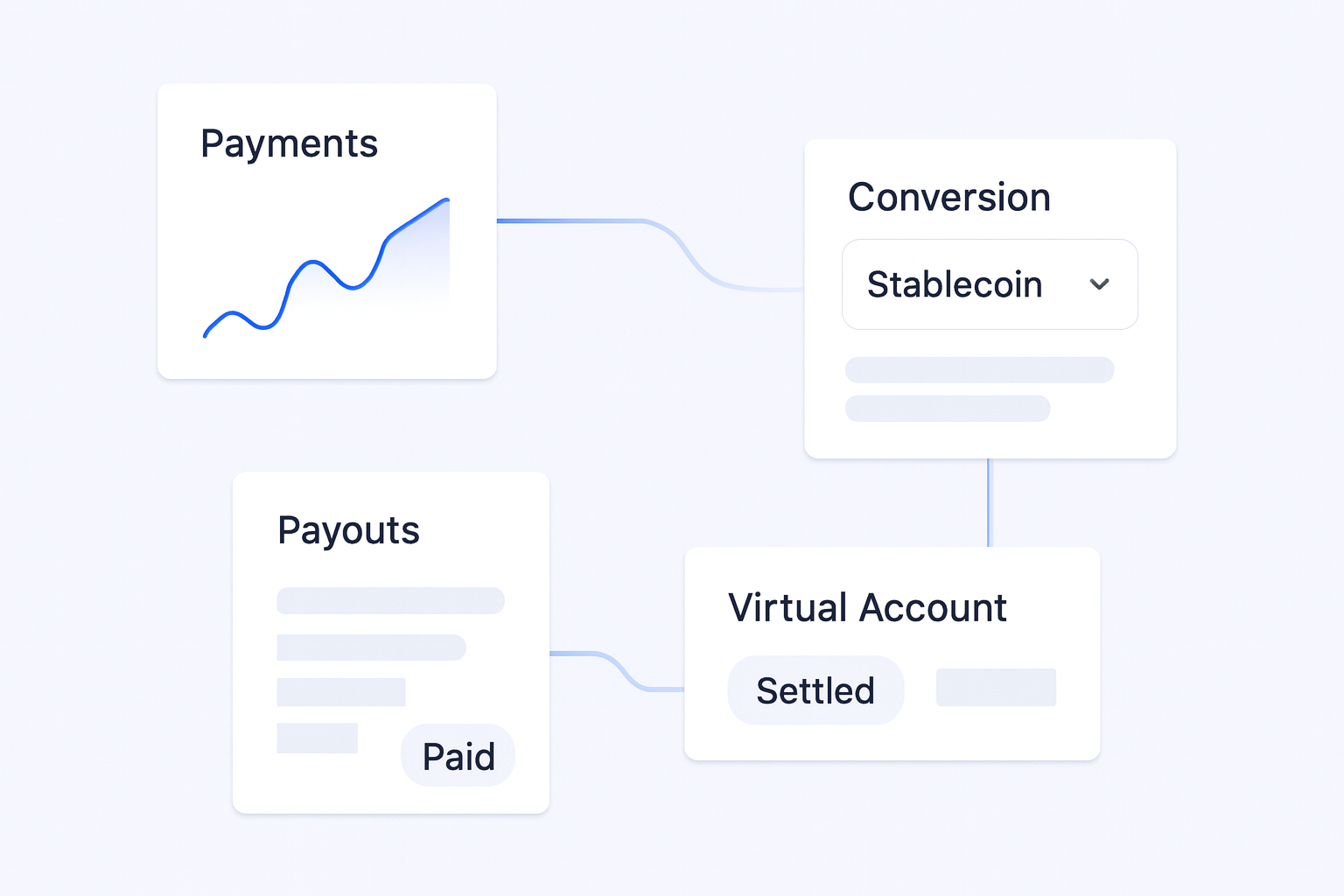
Radom is built for that operating use case. It helps businesses accept crypto payments, manage balances, convert between assets, and move funds into the rail that fits the next step in the workflow. See crypto payments and crypto convert.
What you need before you start
Before setting up stablecoin payments, decide three things:
- What you want to accept. For most businesses, that means choosing the payment type, such as checkout, invoices, payment links, subscriptions, or payouts.
- What asset you want to hold. Some teams keep balances in stablecoins. Others convert to fiat for reporting, payroll, or supplier payments.
- Where the funds should go next. That may be treasury, a virtual account, a payout run, or another wallet.
If your team needs to receive funds, reconcile balances, or move between fiat and crypto, Radom also supports virtual account and on and off ramp workflows where available. Explore on and off ramp tools.
How to set up stablecoin payments step by step
- Choose the payment flow. Start with the business model. If you need one-time collection, use checkout, payment links, or invoices. If you need recurring collection, use billing and subscriptions. If you need to pay many recipients, start with payouts.
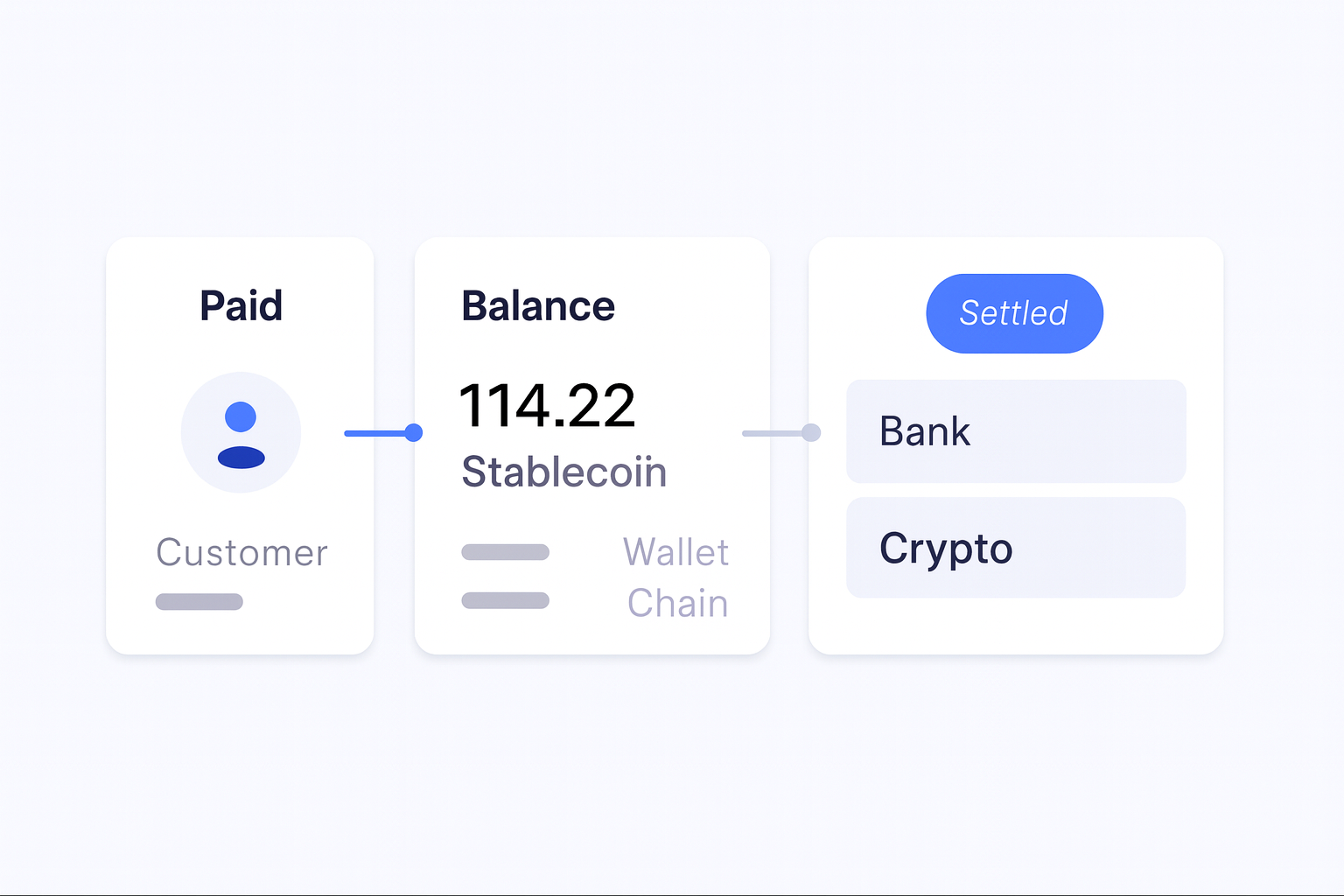
- Define your settlement rule. Decide whether you want to keep funds in crypto, convert to another digital asset, or settle into fiat. This decision matters because it affects treasury, reconciliation, and how finance reports the movement.
- Set up the receiving destination. Map where funds should land after payment. That may be a Radom balance, a wallet, or a payout workflow depending on the use case and available rails.
- Test the payment path. Run a small end-to-end transaction and confirm the payment status, balance movement, and settlement record are what your finance team expects.
- Document the operating process. Make sure finance, operations, and support teams know how to trace a payment, review a conversion, and confirm payout status.
- Scale with the right interface. If your team wants a no-code start, use the dashboard tools. If you need automation, use the API and docs.
For developers, the fastest route to implementation is the product documentation. Open the Radom docs.
Where Radom removes manual work
Stablecoin payment setups often become messy when collection, conversion, and settlement are handled in different tools. Radom reduces that operational load by keeping payment acceptance, balance management, conversion, and payout workflows in one platform.
- Accept crypto payments through hosted checkout, payment links, invoices, subscriptions, or APIs.
- Move between supported digital assets, stablecoins, and fiat where available.
- Track balances and settlement from one place.
- Use payout tools when the next step is to pay affiliates, creators, contractors, or users.
- Route commercial intent to the right product page instead of forcing a custom build.
If your use case is primarily collection, start with crypto payments. If your use case is recurring revenue, use crypto billing. If your use case is payout-heavy, use mass payouts.
How to think about settlement and treasury
Stablecoin payments are only useful if the business can explain what happens after funds arrive. Finance teams usually need a clear answer to one of three questions: do we keep the asset, convert it, or move it out?
Radom’s product direction is built around those workflows. Businesses can accept payments, manage balances, convert between assets, and support treasury movement without stitching together separate tools for every step. If you need to compare pricing as volume grows, review Radom pricing and speak to sales for higher-intent or higher-volume requirements.
Common setup mistakes to avoid
- Starting with a payment flow before deciding the settlement rule.
- Letting finance discover the workflow after live payments have already started.
- Using separate tools for acceptance, conversion, and payouts without a clear reconciliation process.
- Choosing a setup that works for one team but not for operations or support.
A better setup is the one your team can explain, reconcile, and repeat.
When to use Radom
Radom is a good fit if you want a business payments platform that can handle stablecoin collection, conversion, settlement, and payout workflows from one account. It is designed for businesses and platform operators, not consumer wallets, and it fits teams that need practical financial infrastructure rather than speculative crypto features.
For the fastest path, choose the product that matches your workflow, then sign up or contact sales based on implementation complexity.
Contact sales if you want help mapping your payment, conversion, or payout flow. If you are ready to test the product, sign up to Radom.
Frequently asked questions
What is the best way to set up stablecoin payments for a business?+
Start with the business process, not the asset. Decide whether you need checkout, invoices, subscriptions, payment links, or payouts, then define where funds should settle and who needs to reconcile them.
Do stablecoin payments have to stay in crypto?+
No. Many businesses use stablecoins as a collection or transfer layer, then convert or settle into fiat depending on treasury and reporting needs.
Can Radom help with both collection and payouts?+
Yes. Radom supports crypto payments and mass payouts, so teams can manage both sides of the workflow in one platform.
Can developers integrate stablecoin payment flows?+
Yes. Radom supports APIs and documentation for teams that want programmable payment infrastructure.
Should I use sales or self-serve setup?+
Use self-serve if you are testing a straightforward payment flow. Use sales if you need help with volume, settlement design, or a more complex operating model.