
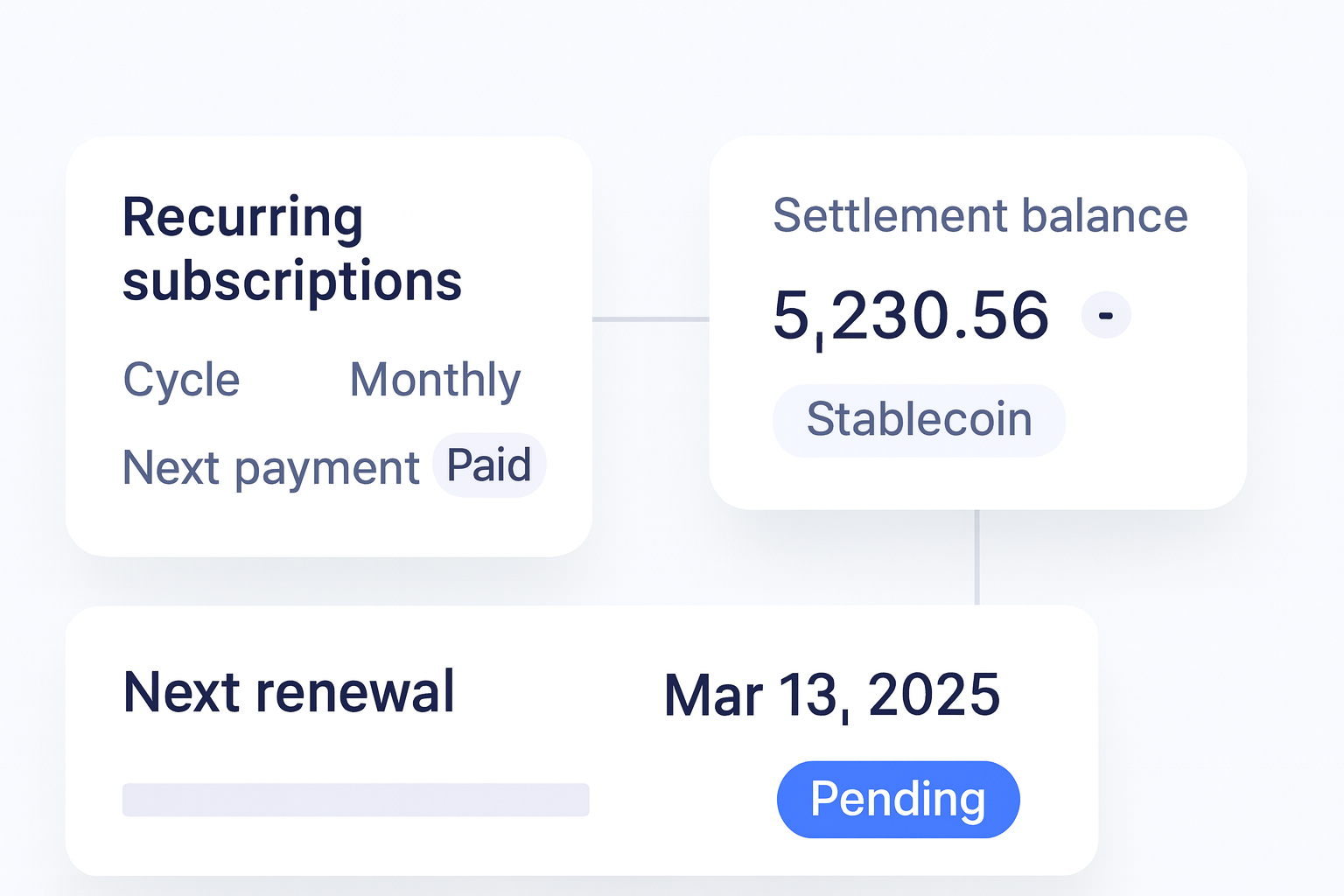
Recurring crypto payments are for businesses, not experiments
If you are selling subscriptions, memberships, usage-based services, or repeat access in crypto, the real question is not whether customers can pay once. It is whether your team can run renewals, track payment states, manage settlement, and reconcile revenue without building a custom payment stack.
Radom is built for that operating problem. It gives businesses tools for crypto billing, subscriptions, invoices, payment links, payments, and APIs from one platform. That makes it a fit for SaaS teams, platform operators, finance operations teams, and other businesses that need repeatable revenue collection in crypto.
If you already know the model you need, start with crypto billing or crypto invoicing. If you want to review pricing first, see Radom pricing.
What recurring crypto payments usually include
Recurring crypto payments are more than charging a wallet on a schedule. In practice, teams usually need a few connected pieces:
- A subscription or renewal model that fits the product.
- A customer payment flow that is clear on desktop and mobile.
- Payment states that show whether a renewal succeeded, failed, or needs attention.
- Invoice or billing records for finance and support teams.
- Settlement and reconciliation workflows so revenue can be tracked properly.
Radom's billing tools are designed around those needs. The platform supports recurring payments, billing, invoicing, payment links, and payment APIs, so teams can choose between hosted tools and developer-led integration.
How to set up recurring crypto payments with Radom
- Define the billing model. Decide whether you need fixed subscriptions, usage-based billing, tiers, seats, trials, discounts, add-ons, or custom renewal cycles.
- Choose the customer flow. Use hosted billing tools if you want to move quickly, or use APIs if you need to embed the experience into your product.
- Set up the payment object. Create the subscription, invoice, or renewal flow that matches the way you charge customers.
- Track payment states. Make sure your team can see successful payments, failed payments, and customer activity from one place.
- Connect operations. Give finance, operations, and product teams the access they need to manage billing without sharing everything with everyone.
- Review settlement and reporting. Confirm how funds move into your Radom balance and how your team will handle reconciliation.
For teams that want to implement quickly, the practical next step is to review the product docs and decide whether the hosted flow or API path fits best. If you are building, start with Radom documentation. If you want to talk through the setup, use contact sales.
Where Radom removes work
Recurring revenue workflows often break down in the same places: payment collection, failed renewals, status visibility, and finance handoff. Radom reduces that work by giving teams one platform for billing, invoices, payment links, and APIs, rather than stitching together separate tools for each step.
That matters when your team needs to:
- Track recurring revenue and failed payments from one dashboard.
- Support billing models that buyers expect.
- Give finance and operations teams the right access.
- Use hosted tools for speed or APIs for product integration.
For businesses that also need broader payment acceptance, Radom's crypto payments page is the right place to compare hosted checkout, invoices, subscriptions, payment links, and APIs in one place.
When recurring crypto payments make sense
Recurring crypto payments are usually a good fit when your customers already operate in crypto or stablecoins, when you sell globally, or when your billing flows need to match a digital-native audience. They are also useful for SaaS, creator platforms, affiliate programs, and other recurring revenue businesses that want a more direct payment rail for certain customer segments.
They are less useful if your team only needs a one-off payment page or a simple invoice. In that case, a lighter flow such as crypto payment links may be enough. If you need a broader billing system with recurring revenue and invoice support, Radom's billing and invoicing tools are the better starting point.
What to check before you launch
Before you go live, your team should confirm the billing model, customer experience, payment state handling, and settlement workflow. That review is especially important for finance and operations teams that need clean reconciliation and for developers who need predictable API behavior.
If you are comparing plans or want to understand fit for higher-volume use cases, review pricing and then speak with Radom sales if you need a tailored setup.
Frequently asked questions
Can Radom handle recurring crypto payments for subscriptions?+
Yes. Radom's billing product is designed for subscriptions and recurring services, with support for billing models such as tiers, usage-based plans, trials, discounts, add-ons, and custom renewal cycles.
Can I use APIs instead of a hosted flow?+
Yes. Radom offers payment APIs for teams that want to integrate recurring billing directly into their product or internal systems.
Does Radom also support invoices?+
Yes. Radom includes crypto invoicing, which can be useful for finance teams, contractors, agencies, and service businesses that need invoice-based collection alongside recurring billing.
Where should I start if I am still evaluating the product?+
Start with crypto billing if recurring revenue is the main use case, or review pricing if you want to understand the commercial setup first. If you need implementation detail, use the docs.
Next step
If recurring crypto payments are part of your revenue model, Radom gives you a practical way to run billing, invoices, payment links, and APIs from one platform. Contact sales if you want help mapping the flow, or open the docs if you are ready to build.

