Compare recurring crypto payments options
If you are evaluating recurring crypto payments for SaaS, platforms, or subscription businesses, the real question is not whether a provider can collect a payment once. It is whether the workflow can handle subscriptions, payment states, invoices, customer management, and settlement without forcing your team to stitch together separate tools.
Radom is built for businesses that want to accept crypto payments, manage subscriptions, send invoices, create payment links, and run payouts from one platform. For recurring revenue teams, that means you can compare Radom on the basis that matters most: whether your billing stack supports the way finance, operations, and product teams actually work.
See Radom pricing for the current pricing model, then use contact sales if you need to discuss higher volume or a more specific subscription setup.
What to compare in a recurring crypto payments platform
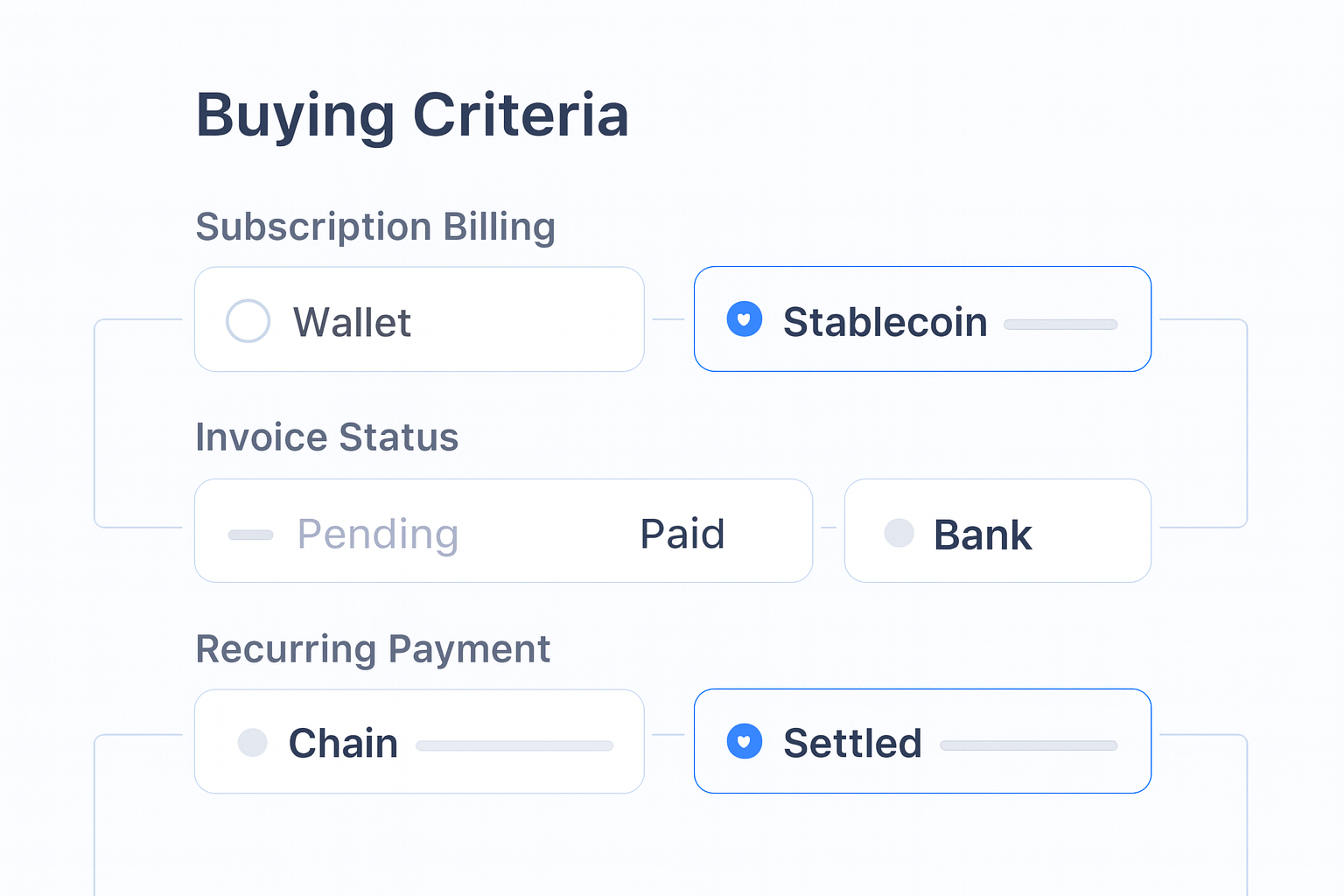
When buyers compare recurring crypto payments tools, they usually need a practical answer to five questions.
- Can the platform support the billing model you use, such as fixed subscriptions, metered usage, seats, tiers, free trials, discounts, add-ons, or custom renewal cycles?
- Can finance and operations teams see payment states, customer activity, and settlement in one place?
- Can developers integrate billing through APIs when needed, while still giving non-technical teams a usable dashboard?
- Can the platform handle invoices and recurring customer communication without sending teams to another system?
- Does the pricing model fit your transaction volume and operating model?
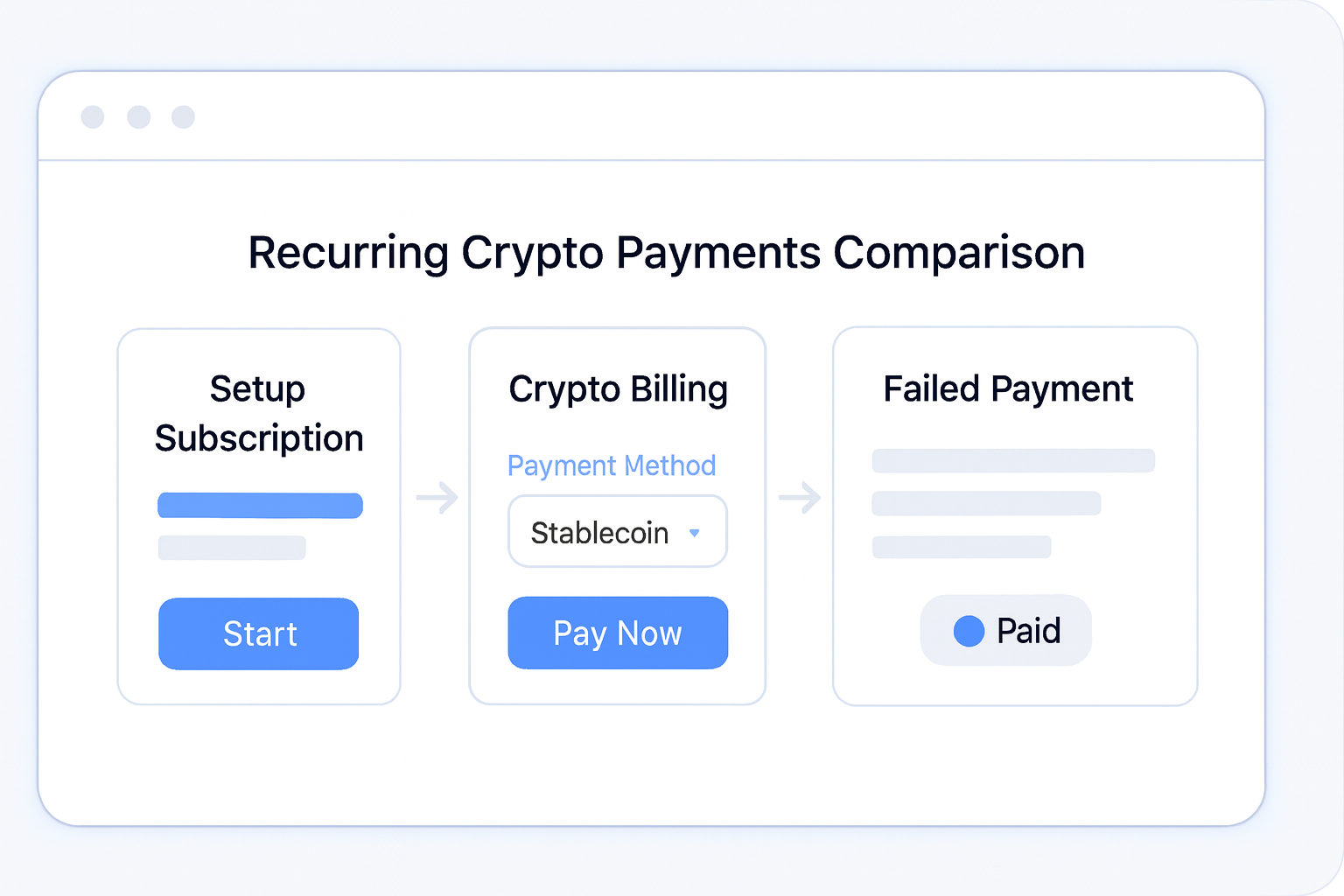
Radom's billing product is designed around those workflows. The platform supports recurring payments, clear payment states, customer-friendly wallet flows, and access controls for billing management. It also supports billing models that include metered usage, seats, tiers, free trials, discounts, add-ons, and custom renewal cycles.
Where Radom fits
Radom is a strong fit if you need recurring crypto payments as part of a broader payments stack, not as a standalone billing widget. The platform brings together billing, invoicing, payment links, checkout, and payouts so teams can manage customer collections and downstream money movement from one account.
That matters for SaaS teams, creator platforms, affiliate businesses, iGaming operators, and other digital businesses that need a reliable way to collect recurring revenue and keep finance teams aligned on settlement and reporting.
For SaaS-specific billing workflows, see crypto billing and invoicing for SaaS. For one-off customer collection flows, compare crypto checkout and crypto payment links.
What Radom removes from the workflow
Radom reduces the number of separate tools your team needs to manage recurring crypto revenue.
- Subscription setup happens in the same platform as payment tracking.
- Finance teams can track recurring revenue and settlement without moving between systems.
- Operations teams can manage billing access with roles and permissions.
- Developers can use APIs when they need to automate invoice creation, payment tracking, reminders, and reconciliation.
If your team wants to automate invoice-driven subscription workflows, review crypto invoicing. If you need payment collection for a lighter workflow, use payment links as a no-code option.
How to choose the right setup
- Start with your revenue model. If you sell subscriptions, make sure the provider supports the cadence and pricing structure you need.
- Check the finance workflow. Ask how payment states, settlement, and reconciliation are handled.
- Review the customer flow. The payment experience should be clear across wallets and devices.
- Confirm the operational controls. Roles and permissions matter once more than one team owns billing.
- Compare pricing and support needs. Use the published pricing page first, then involve sales if your volume or setup is more complex.
Radom's pricing is structured as per-transaction pricing with no setup fees or monthly fees on the published page. If your use case needs a more tailored discussion, contact sales.
Decision guide for teams comparing providers
Choose a provider that matches your operating model, not just your checkout flow.
- If you want hosted tools and a straightforward billing setup, Radom's dashboard-led workflow is a good place to start.
- If you want developer control, use the API documentation alongside the product pages.
- If your team needs recurring billing plus invoices and payouts, compare the broader platform rather than only the subscription feature.
For teams already evaluating the wider stack, the most relevant next steps are pricing, crypto billing, and contact sales.
Frequently asked questions
Is Radom only for one-time crypto payments?+
No. Radom supports billing, subscriptions, invoices, payment links, payouts, and payment APIs, so it can be used for recurring revenue workflows as well as one-time collection.
Can Radom handle different subscription models?+
Radom's billing product supports billing models including metered usage, seats, tiers, free trials, discounts, add-ons, and custom renewal cycles.
Do finance teams get visibility into recurring revenue?+
Yes. Radom's billing page states that teams can track recurring revenue, failed payments, customer activity, and settlement from one dashboard.
Should we use billing, invoicing, or payment links?+
Use billing for recurring subscriptions, invoicing for invoice-led collections, and payment links for a lighter no-code payment flow. The right choice depends on how your customers buy and how your team wants to manage the workflow.
Where should we start if we are comparing vendors?+
Start with the pricing page, then review the billing product page and contact sales if your volume, workflow, or implementation needs a more specific review.
Next step
Review Radom pricing, then compare the billing workflow against your current subscription stack. If you want to discuss fit for SaaS, platforms, or recurring revenue operations, contact sales.