
Send EUR payouts from USDC without building payout ops from scratch
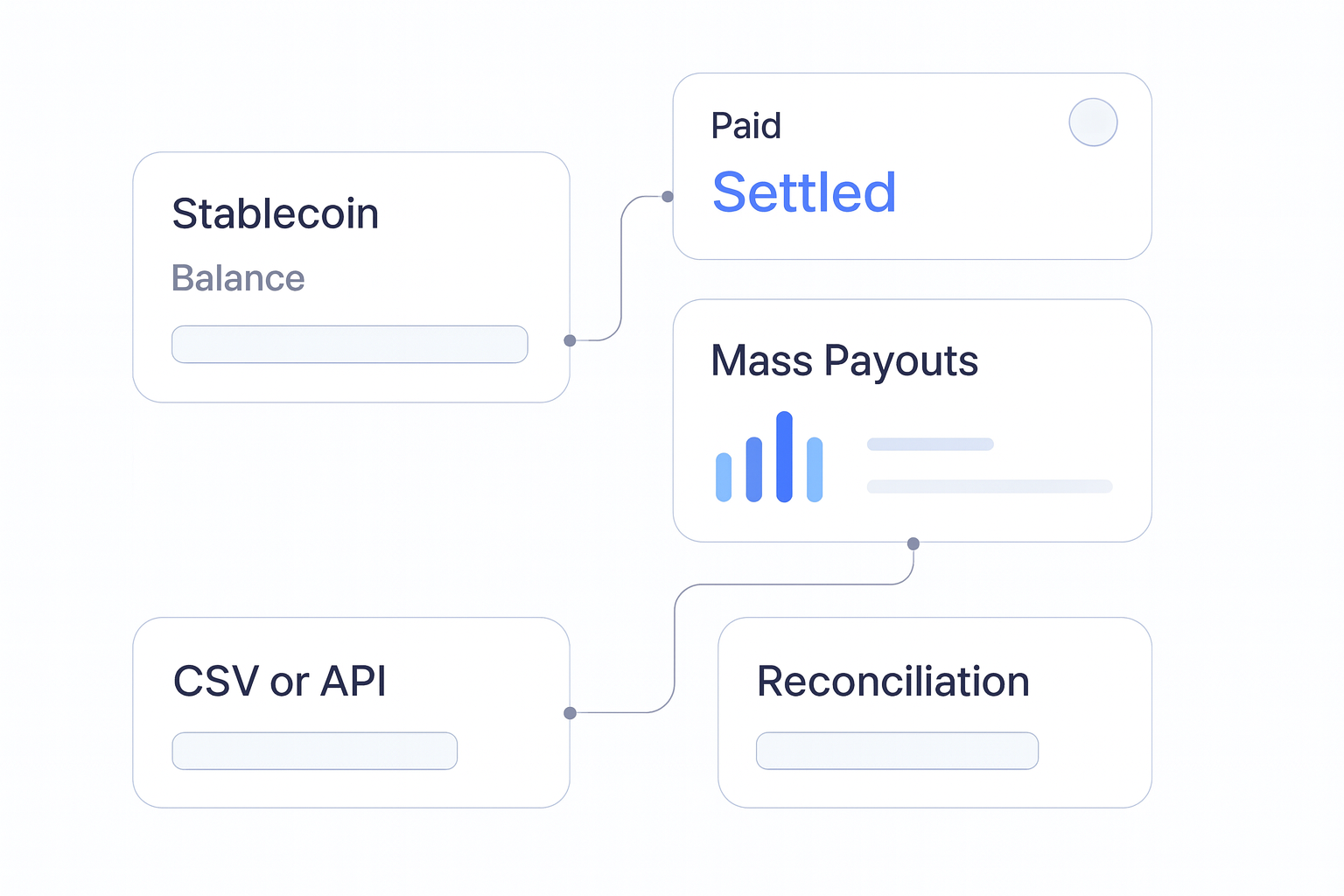
If your business already holds USDC or settles in stablecoins, Radom gives you a practical way to fund mass payouts and send EUR to recipients where supported. Use the dashboard, CSV upload, or API to run repeat payout workflows for affiliates, creators, contractors, sellers, and users.
This is built for operators who need control over payment rail, currency, status tracking, and settlement, not a consumer wallet experience. Radom supports payout workflows across crypto and fiat, with conversion where required and tools that help finance teams keep records cleaner.
Contact sales about Radom payouts
How USDC to EUR payout workflows work
- Fund your payout balance in USDC or another supported crypto or fiat rail.
- Choose the recipient list in the dashboard, upload a CSV, or send payouts through the API.
- Convert funds where needed so recipients can be paid in EUR through supported rails.
- Review payout status, settlement, and recipient records from one place.
- Use the same workflow again for recurring payout runs, partner payments, or platform disbursements.
Radom removes the need to stitch together a separate converter, payout processor, and reconciliation layer for every run. That matters when payout volume grows and finance teams need a repeatable process.
Where Radom fits for payout-heavy businesses
Radom is a fit for marketplaces, affiliate networks, iGaming operators, creator platforms, subscription businesses, and other digital businesses that need to move money at scale. The same platform can support crypto payouts, fiat payouts, and conversion workflows, which helps teams avoid fragmented operations across multiple tools.
For developers, the Radom documentation covers integration paths for platform payout automation. For teams that want to collect fiat and manage balances before payout, virtual accounts and crypto on and off ramp workflows may also be relevant.
What finance and operations teams usually care about
- Clear recipient records and payout status
- Support for repeatable payout operations through dashboard, CSV, or API
- Conversion between crypto and fiat where supported
- EUR payout delivery through supported rails
- Settlement and reporting that help with reconciliation
Radom is positioned as payment infrastructure for businesses, so the focus stays on operational control, not speculation.
When to use Radom for USDC to EUR payouts
Use Radom if you need to pay many recipients from stablecoin balances and want a single workflow for funding, conversion, payout execution, and tracking. It is especially useful when your payout process needs to support different recipient preferences, different currencies, or both crypto and fiat settlement paths.
If your team is still deciding between direct crypto payouts and fiat recipient payouts, start with the payout use case that matches your recipient base, then expand from there.
Frequently asked questions
Can Radom send EUR payouts funded by USDC?+
Radom supports mass payouts in crypto and fiat, and its product pages state that payouts can be funded in crypto or fiat and sent in supported currencies and rails where available. Exact availability should be confirmed for your use case.
Can I run payouts from the dashboard, CSV upload, or API?+
Yes. Radom's payouts page says you can send payouts through the dashboard, CSV upload, or API.
Does Radom support reconciliation and settlement tracking?+
Radom's product pages describe payment and exchange analytics, settlement, and tracking tools that help finance and operations teams manage payout workflows.
Is Radom only for crypto-native companies?+
No. Radom is positioned for businesses and platform operators that need practical payment infrastructure across crypto, stablecoins, fiat, and open banking where available.
Where should I start if I want to integrate payout automation?+
Start with the documentation if you are evaluating the API. If you want to discuss volume, currencies, or payout structure, contact sales.

